


Is current energy policy at odds with food security? JP Garnier asks the question.
In its June report on solar energy, the Government revealed its plans to cover 0.4% of the UK landmass with glass panels. The highly subsidised, fast-tracked projects are being rushed through to blanket prime farmland, particularly in the east of England.
Few people would object to solar energy, despite its intermittence and low yield in the British climate, subject to the caveats of low or no state subsidies, locally produced panels (i.e. not in China), that panels are designed for a long life and are recyclable, that energy household bills remain affordable… and that they don’t cover prime crop and pasture land, at a time when acres of distribution centres and other industrial buildings are available for that use.
The glass panel craze adds another nail in the coffin of UK food production and food security.
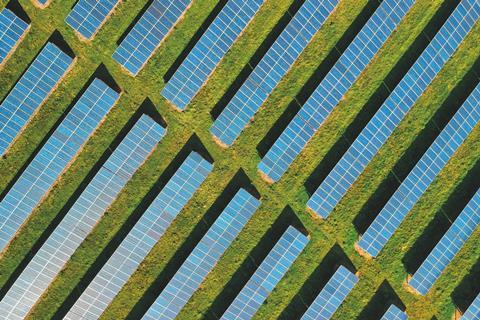
Of course, some may argue that the loss of crop land will benefit the meat sector, as sheep graze in the solar parks. There are even rare examples of the introduction of cattle. Yet, all too often, the sheep are used to keep land tidy rather than as true agricultural enterprises.
Ed Miliband, the Secretary of State for Energy Security and Net Zero, claimed in Parliament that wind and solar are “nine times cheaper than gas”. So, how come? The answer is that renewables look cheap if you focus only on their marginal costs and exclude all the system costs, such as the new infrastructure and the forest of electricity pylons needed to accommodate intermittent energy (is it what he means by “planting forests”?).
The inconvenient fact is that we now need roughly 120 gigawatts (GW) of installed generation capacity to meet the same demand that 60GW met pre-renewables, twice the transmission lines and pylons, and all the back-up batteries and storage. So, if renewable energy is so cheap to produce, why do we subsidise it, and why is the price of electricity so high in the UK?
Let’s not forget that the high cost of electricity is hurting the competitiveness of British meat processors.
At a time of low growth and financial strain for state, enterprises and households, do we really need to opt for more impoverishment?
Gillian Martin, the Scottish Climate Action Secretary, reportedly told MSPs that the effects of climate change, from floods to wildfires, were already being felt across Scotland, saying that “Parliament must act decisively and together” to address them. No, Ms Martin, Scotland will not solve the climate crisis alone, greenhouse gas emissions are not a Scottish problem with Scottish solutions, as gases know no boundaries and, really, it is what is happening in China, India and the USA that matters.
Despite the hard-won concession by Mairi Gougeon of not cutting further the Scottish herd, crippling Scottish farming and meat processing with more norms and costs will only lead to exporting food production to higher-emitting countries, with a net negative effect, as it has become clear with the consequences of UK deindustrialisation. Moreover, a detailed timetable, financing options and impact assessment are missing in the grand plan. The Germans have invented a great word to describe it: scheinheilig: an extreme hypocritical do-gooder.
In December 2019, the front cover of Meat Management had “Auntie’s got an axe to grind” splashed across it, suggesting a bias at the BBC on meat matters. I acknowledge that the organisation has somehow tempered its once strongly held, simplistic views on farming and nutrition, however, a rapid look at the BBC Food site shows many instances of continuing bias. The current furore on the ‘liberal’ bias at the broadcaster and the demand for more balance, facts and science (real science, not conveniently hand-picked science) should extend to farming, food and sustainability.