


Red meat processor ABP UK has published the Year Three Report from its PRISM 2030 sustainability programme, finding that average beef emissions had reduced by 8.3%.
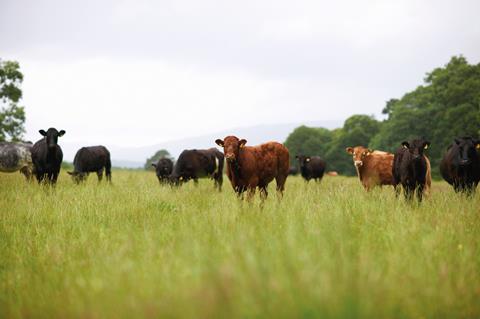
The sustainability programme, which ABP said was worth £1.5 million, aims to provide insight into the factors associated with carbon performance across UK beef and lamb production.
Working with more than 300 beef and sheep suppliers, the ABP PRISM 2030 programme has the aim of building a “stronger evidence base” around farm emissions and identifying practical opportunities for improvement. Across the first three years of the programme, farm data was independently analysed by Harper Adams University (HAU).
HAU found that across two full carbon assessment cycles, the programme had generated 1.4 million data points, creating a “substantial primary dataset” on UK livestock emissions.
The Year Three Report shows average beef emissions reduced by 8.3% between the programme’s two assessment phases, from 21.8kg to 20kg CO₂e/kg deadweight, while average lamb emissions reduced by 1.3%, from 23.5kg to 23.2kg CO₂e/kg deadweight.
Farms reporting management changes since their first assessment also recorded lower carbon footprints than those reporting no change, with emissions 8.2% lower among beef enterprises and 13.9% lower among lamb enterprises. While the report does not attribute these differences to individual interventions, the findings were said to provide a “stronger basis” for understanding how management, productivity and efficiency relate to emissions.
Phil Hambling, director of agriculture and sustainable sourcing at ABP, said: “The Year Three data shows that we are starting to build a much clearer picture of what sits behind differences in carbon performance between farms.
“There is no single change that will deliver the same result for every business, but the findings are showing how closely emissions can be linked with productivity, efficiency and the way an individual system is managed. That gives us a much stronger basis for helping farmers understand where opportunities may lie within their own business.
“PRISM was always intended to be a long-term investment in building evidence, so extending our work with HAU allows us to take the next step. We now want to understand which changes deliver results, how they stack up commercially and what motivates farmers to adopt them, so that the learning can ultimately benefit a much wider group of beef and sheep producers.”
ABP and HAU have extended their partnership through to 2032, with three further rounds of carbon footprinting planned in 2027, 2029 and 2031. ABP said this would allow researchers to track farm performance over a longer period and build on the 1.4 million data points already collected through PRISM.
ABP highlights importance of comparing like-for-like emissions
The Year Three Report detailed a link between biological efficiency and emissions, and after accounting for changes in livestock stocked and sold, lower-emitting beef farms were found to be three times more efficient than higher-emitting farms. The results also highlighted the importance of comparing like-for-like farming systems, with enterprise type having the greatest influence on beef emissions.
ABP said that future analysis will broaden to include farm economics, whole-farm nutrient circularity and nutritional life cycle assessment, alongside continued knowledge exchange with farmers and the wider agriculture sector. Its longer-term ambition will be to use the findings from PRISM to support the expansion of carbon footprinting across ABP’s wider beef and lamb supply base, giving more farmers access to farm-level data and helping identify where practical improvement can be made.
Hambling continued: “For retailers, food manufacturers and other businesses across the food chain, this growing evidence base will provide greater insight into the environmental performance of beef and lamb production and help inform approaches to long-term sustainability.”