




According to the Agriculture and Horticulture Development Board (AHDB), cattle and sheep prices remain at “record levels” despite falling over the Easter period.
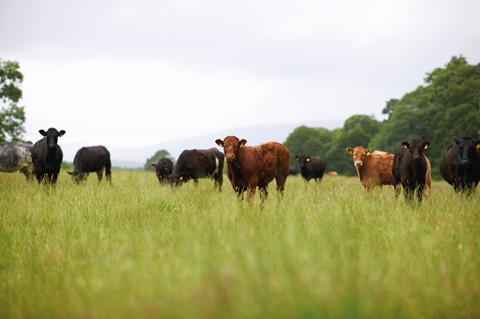
GB deadweight prime cattle prices saw a “slight increase” in the week ending 11th April. The average all-prime price reached 635p/kg, rising by just 0.3p on the week. The price now sits 61p below the same week of last year as AHDB annualises against a period of steep price climbs.
Within this, the average steer price reached 635p/kg, declining by 1p on the week and standing 62p lower than the same period last year. This is, however, 133p/kg above the five-year average.
Estimated GB prime cattle slaughter totalled 30,100 head, showing a slight increase (500 head) against the previous week. Cull cow slaughter numbers increased by 300 head to 7,100 head.
AHDB said that more broadly, cattle prices had been supported by “stronger seasonal demand” and reduced production capacity over the Easter holiday period. Fewer processing days led to a tightening in short-term supply and has likely contributed to firmer prices.
From a global perspective, an outbreak of foot and mouth disease has been reported in China, affecting 6,229 cattle, with the origin believed to be linked to Africa. AHDB warned that the situation warrants “close monitoring” in the coming months due to its potential implications for global trade.
Lamb throughput constrained over Easter
The GB deadweight old season lamb (OSL) standard quality quotation (SQQ) fell by 19p in the week ending 11th April, reaching 847p/kg. This sits 136p higher than the same week last year.
In the week ending 12th April, the liveweight OSL SQQ for England and Wales (E&W), rose by 2p to 413p/kg, which was 79p higher than during the same week in 2025. Throughputs of finished lambs through the live markets declined by 17% on the week to 35,900 head, and AHDB said that consistent declines over the past few weeks likely signalled the tapering of old season supplies.
AHDB estimated weekly GB clean sheep slaughter increased slightly, totalling 191,400 head, an increase of around 1,400 head on the week. However, reduced processing capacity constrained throughput over Easter as fewer operational days limited overall production.
While week-on-week increases were observed, slaughter levels were not directly comparable to typical full production weeks as a result.