


The Food Standards Agency (FSA) has partnered with Food Standards Scotland (FSS) to draw up the UK’s first safety guidance for cell-cultivated products (CCPs).
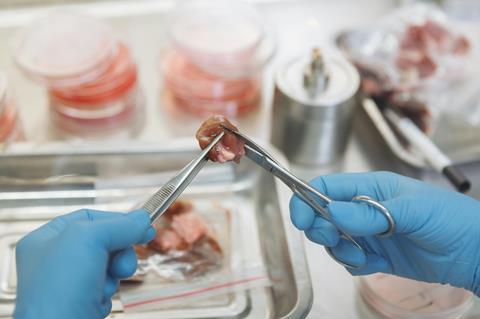
Following the creation of the FSA and FSS’s CCP Sandbox Programme in February 2025, which focuses on animal cells only, two pieces of guidance have been produced. The guidance applies to businesses based in England, Wales and Scotland involved in the production of cell-cultivated products.
CCP assessment and regulation
In the first piece of guidance, ’Cell-cultivated products: guidance on classification and HACCP principles’, FSA confirms that cell-cultivated products produced using animal cells, sometimes called ‘lab-grown meat’, are defined as products of animal origin. It states that this means that businesses must apply existing food safety regulations during the production process.
The second piece of guidance relates to allergenicity assessments and nutritional quality, and how this will be assessed as part of the approval process for all cell-cultivated products.
Dr Thomas Vincent, deputy director of innovation at the FSA, commented: “Our new guidance provides clarity for businesses, helping them to understand and correctly demonstrate to UK food regulators how their products are safe.
“Specifically, this guidance ensures that companies have assessed potential allergenic risks and that they are nutritionally appropriate before they can be authorised for sale. Consumers can be reassured that these innovative new foods will meet the same rigorous safety standards as conventional foods.
“The Sandbox programme is allowing us to fast-track regulatory knowledge to reduce barriers for emerging food technologies without compromising on safety standards.”
The Sandbox Programme is funded by the Department of Science and Technology (DSIT) through the Engineering Biology Sandbox Fund. FSA stated that the guidance has been developed using a “robust, science-based framework” and that further guidance is due to be released throughout 2026.
The FSA also noted that the guidance is not law. It has been produced to provide guidance on the legal requirements of production of cell-cultivated products and should be read together with the relevant legislation.