The judgment of the judicial review brought by the Association of Independent Meat Suppliers (AIMS) and the British Meat Processors Association (BMPA) against the Food Standards Agency (FSA) will mean hourly rates for official controls and enforcement must be quashed.

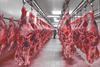
Hanging carcasses abattoir

Source: iStock

In a statement, AIMS and BMPA said this was a “devastating judgment” for the FSA, as the High Court has found that its charging for official controls has been taxing slaughterhouses unlawfully.

Judgment a victory for abattoirs and livestock farmers

The FSA is responsible for carrying out food hygiene and safety checks at slaughterhouses in England and Wales, called ‘official controls’, which are undertaken by official veterinarians. Operators are required by law to contribute towards the costs incurred. These charges are published in the form of Cost Data Slides and can be split into a Meat Controls Hourly Rate (known as the ‘main rate’) and an Hourly Enforcement Rate. 

In the judicial review, AIMS, supported by the National Farmers’ Union (NFU), argued that:

  • The FSA’s main rate and enforcement rate included charges for activities that it was not lawfully allowed to charge for.
  • The FSA should not be able to charge for inspections by novice official veterinarians and temporarily registered novice official veterinarians, as they do not meet minimum qualification requirements.
  • The FSA failed to meet the required standard of transparency as the Cost Data Slides did not include sufficient information of what costs were included in the charges.

The current cost of the controls is £64 million annually, and charges increased this year by 24%. In view of the low profit margins in the industry, AIMS and BMPA stated that this increase will not only “add to food inflation and the cost of living, but also endanger the viability of many slaughterhouses in England and Wales”, with the effect of reducing consumer choice.

In the judgment handed down by Mrs Justice Dias, it has been ruled that the FSA’s main rate and enforcement rates are unlawful and that the Cost Data Slides do not contain enough detail. The NFU hailed this as a “huge victory” for all abattoirs, and in particular, the small and medium sized businesses and the farmers that supply them.

Court ruling provides clarity on permissible charges

The ruling means the Court must quash the hourly rates for both official controls and enforcement as well as the Cost Data Slides providing information on how those rates were calculated. The judge will now hear further argument on the precise terms of the court’s order.

The judgment, which can be found in full below, has provided clarification on what the FSA can lawfully charge for, both in terms of relevant activities and the personnel whose time can be charged for. BMPA and AIMS added that the latter aspect related to “the FSA seeking to charge for numerous improperly qualified veterinarians employed by its private contractors in relation to the controls that industry has long complained were not being carried out to a high standard.” 

Industry bodies call for an urgent review of the charging regime

Jason Aldiss, executive director at AIMS.

Jason Aldiss, AIMS.

Jason Aldiss, executive director of AIMS, stated: “The judgment must now mark the beginning of a complete reset in the relationship between the regulator and the meat industry, founded upon legality, proportionality, transparency and scientific risk-based regulation.”

Harry Russell of Roythornes LLP (solicitors for AIMS) added: “The dust has yet to settle but this is a damning indictment of long-standing FSA practice. We can only hope that this will lead to meaningful change to ensure quality food hygiene and safety checks under a system supporting our home-grown industry and giving consumers affordable and varied choice.”

“The BMPA welcomes the judge’s findings, which recognise and have exposed long-standing weaknesses in the FSA’s charging policy.”

John Powell, BMPA

John Powell, BMPA CEO

John Powell, BMPA.

John Powell, CEO of the BPMA, commented: “The BMPA welcomes the judge’s findings, which recognise and have exposed long-standing weaknesses in the FSA’s charging policy. We will now work closely with the FSA to ensure a fairer and more transparent system for the delivery of official controls can be quickly implemented going forward.

“The burden of FSA charges on our industry is significant when we are responsible for ensuring the country is fed, safeguarding food security and upholding the highest standards of food safety and animal welfare.”

NFU responds to court’s findings

The NFU stated that it had long held the view that the charges risk seriously impacting the wider livestock sector and has consistently urged Government to carry out a full review of the FSA’s charging regime to ensure that charges are “fair and equitable and do not disadvantage UK businesses”. It said it had also asked for the charges to be postponed since the outbreak of the war in the Middle East to help ease pressures on livestock farmers.

“Abattoirs play a vital role in the nation’s food supply chain, yet in recent years the sector has faced significant consolidation, with many small and medium-sized businesses forced to close.”

Tom Bradshaw, NFU

Tom Bradshaw, NFU president

Tom Bradshaw, NFU.

NFU president Tom Bradshaw commented: “Today’s ruling is a hugely significant outcome for the livestock sector and is a brilliant result for the meat industry, the NFU and our members. This has been a key issue we’ve consistently raised with government over many months due to the pressure these charges put on abattoirs.

“Abattoirs play a vital role in the nation’s food supply chain, yet in recent years the sector has faced significant consolidation, with many small and medium-sized businesses forced to close. This trend has resulted in serious consequences for livestock farmers as local abattoirs, which provide important services such as private slaughter and support the independent hospitality and retail sectors, have been lost. It also raises concerns around increased journey times and travel costs.

“The increased charges introduced by the FSA have, in some cases, added tens of thousands of pounds to businesses’ bills overnight. These increases placed further strain on meat premises already under pressure from escalating costs and regulatory burdens. The High Court Judge has been clear that these charges are unlawful and we now look to the FSA to rectify this swiftly.”

The claim for judicial review was brought by the Association of Independent Meat Suppliers (AIMS) and British Meat Processors Association (BMPA). Tim Russ and Harry Russell of Roythornes LLP instructed Gordon Nardell KC and James Burton in the case. The NFU provided support and were represented in court.

FSA “disappointed” with court’s conclusions

FSA CEO Katie Pettifer

Katie Pettifer, FSA.

In response to the ruling by the High Court, Katie Pettifer, FSA chief executive, stated: “We have carefully considered the court’s judgment in the judicial review brought by AIMS regarding our meat inspection charges.

“While the ruling does not challenge the principle that we can charge for meat inspection, we are disappointed with its conclusions about how charges are calculated. We acted in good faith in calculating our charge rates and in presenting the information we publish about them and are seeking leave to appeal the judgment.

“While the majority of our charges will not be in dispute, the ruling does create some uncertainty over some elements. We know businesses will want clarity on what this will ultimately mean in practice, and we will provide further information as quickly as the legal process allows.

“Food safety is non-negotiable. Our Official Vets and Meat Hygiene Inspectors carry out essential work every day that protects public health, upholds animal welfare, and underpins the £11.3 billion meat industry. That will not change.”

Downloads