

The International Meat Trade Association (IMTA) has held a reception in Parliament, hosted by Sarah Dyke, Liberal Democrat MP for Glastonbury and Somerton, to celebrate 130 years serving the meat trade.
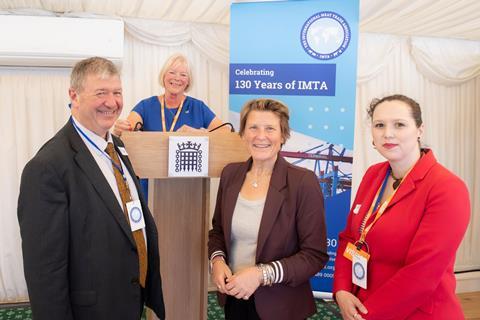
IMTA chair Margaret Boanas MBE welcomed guests from across the meat trade to the Pavilion Terrace in the House of Commons on Wednesday 2nd September for a celebration of the work of the trade body. Boanas joined the board of IMTA in 1986 and has worked closely with Government and industry in her roles at the organisation.
Changing with the times
The anniversary gave speakers the chance to look back at the role of IMTA over the years as well as raise some of the pressures currently faced by the meat trade.
IMTA has been supporting international meat trading since it was formed in 1895 by a group of ten importers of frozen meat, with the aim of achieving better representation of their interests in London’s Smithfield Market.
The organisation has evolved since then, becoming the International Meat Trade Association in 1982, now helping facilitate trade that is primarily in individual chilled muscles rather than frozen meat and reflecting the work of its members, who trade worldwide, exporting as well as importing meat. Today, IMTA’s membership of 65 trading members and 21 associate and affiliate members extends across the whole supply chain, to include producers, shipping lines, cold storage businesses, port facilities, veterinary organisations, hauliers and insurers.

In addressing the collected guests, Boanas noted that her summer reading material, The History of the Frozen Meat Trade, published in 1912, had a reference that was as relevant now as it was at the turn of the last century: “It was soon discovered that there were many questions which could be far better handled by a body representing the frozen meat trade than by individuals.”
Boanas went on to highlight the role of trade in carcase balance and stated: “IMTA has consistently advocated for robust domestic production, coupled with international trade to reduce wastage and increase value for producers.”
Supporting food security and consumer choice
The IMTA reception was hosted by Sarah Dyke, MP for Glastonbury and Somerton, who gave a speech in recognition of the association’s role in facilitating the meat trade and supporting consumer choice, food security and carcase balance. Speaking on the role of trade in a resilient, sustainable food system, Dyke said her work on the Good Food Bill sought to establish better access to healthy, affordable food for consumers, stating: “Achieving this requires support for domestic food production alongside resilient and effective international supply chains.”
Environment, Food and Rural Affairs Committee (EFRA) chair Alistair Carmichael MP echoed these sentiments, stressing the message that food security is national security. He commented: “This is a great industry. The production of food, the production of food security is a contribution to our national security. Trading that, in other parts of the world, is a good thing, which also contributes to our national security.” He added: “We cannot trade what we do not produce.”
In her speech, Dyke also raised the issue of illegal meat imports and the threat they pose to domestic production, undercutting UK producers and increasing the danger of disease entering the country. With cases of bluetongue currently increasing, the number now exceeding 700, she said that vaccination was the most effective tool to combat the disease but highlighted the shortage of vaccinations available to farmers. She commented: “Every day matters with a disease that is moving as fast as this one.”
“Genuine collaboration and co-design between Government and industry are essential.”
Katie Doherty, IMTA
To close the speeches, IMTA CEO Katie Doherty summed up: “IMTA can operate only because of the support we receive from Government and civil servants; from our wider network, including embassies, port health authorities and ports; and, of course, from our members, without whom we would not exist.
“As I often say in my Meat Management column, genuine collaboration and co-design between Government and industry are essential. Today, I want to pay tribute to all those who have worked in partnership with IMTA over many years. Policy made without meaningful engagement with stakeholders rarely works well in the real world; instead, it creates additional costs for businesses and, ultimately, consumers.
“So today is not only about celebrating 130 years of IMTA’s history; it is also about recognising the collaboration that has sustained us.”